

AI and Architecture: More Time for What Is Human
The discussion surrounding artificial intelligence often swings between two extremes. On one side is the promise of a revolution capable of completely transforming the way we work. On the other is the fear that technology will replace activities traditionally associated with human creativity and thought.
In architecture, perhaps the most relevant question is a different one: it is not about understanding what artificial intelligence can do in place of architects, but what it enables architects to do better.
At ARCHITECTS OFFICE, this question has been explored in practical ways. With the creation of a committee dedicated to the subject, artificial intelligence has been integrated not as an end in itself, but as a tool for improving existing processes, eliminating repetitive tasks, and expanding teams’ capacity for analysis and experimentation.
The focus is not on automating creativity. It is on creating more space for it.
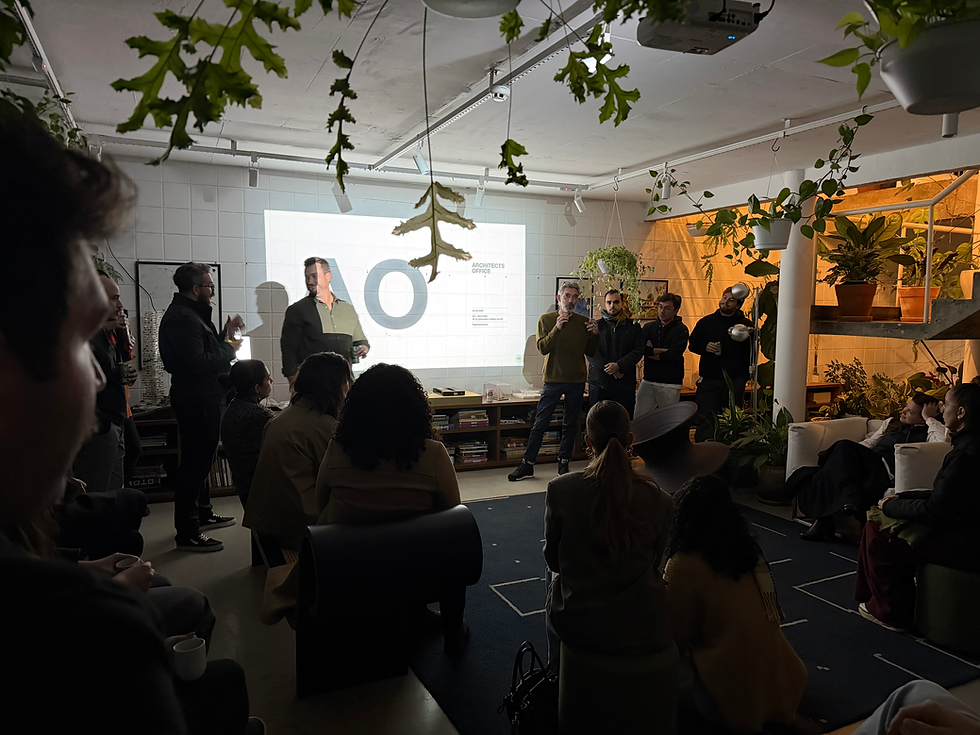
A significant part of architectural work involves activities that consume time but contribute little to the development of ideas: organizing information, producing documents, coordinating data, reviewing materials, and carrying out operational tasks. When these steps are optimized, something increasingly rare in contemporary professional practice becomes available: time to think.
Over the past few months, AO has developed its own tools to automate processes related to modeling, material specifications, cost estimating, and the organization of technical information. Tasks that once took days can now be completed in hours. Repetitive processes have been reduced without compromising the quality or technical rigor required by the firm.
But perhaps the most interesting aspect of this transformation is not efficiency. It is the expansion of our capacity for inquiry.
Today, artificial intelligence already supports teams in the critical analysis of architectural representations, the processing of large volumes of information, the organization of references, and even the development of exploratory scenarios for projects. Rather than functioning solely as a production tool, it is also becoming a resource for reflection, research, and decision-making.
This shift has important implications.
Architecture has always been a discipline rooted in synthesis. Designing means bringing together technical information, urban constraints, human expectations, environmental considerations, and cultural intentions within a single spatial proposal. The more complex cities and projects become, the greater the need for tools capable of handling such vast amounts of information.

Artificial intelligence emerges precisely within this context. It does not replace the human interpretation of data. It does not understand culture, memory, or meaning. But it can significantly expand our ability to access, organize, and connect information that previously remained scattered.

At the same time, its integration requires responsibility. For this reason, AO’s strategy is not based on the indiscriminate adoption of new tools, but on the careful validation of processes. Each application is tested, discussed, and evaluated before being incorporated into the workflow. The goal is not to follow technological trends, but to establish a consistent approach that is aligned with the firm’s culture.
Perhaps this is one of the key lessons of this moment. Artificial intelligence does not diminish the importance of the architect. On the contrary, the more capable the tools become, the more important the human ability to frame questions, interpret contexts, and shape visions for the future becomes.
Ultimately, technology can accelerate answers. But architecture still depends on something no machine can produce on its own: the ability to imagine possibilities that do not yet exist. And perhaps that is precisely what artificial intelligence is giving us more time to do.


